Sustainable is something, that can be sustained over time. Something that we can keep on doing or something that can keep on existing in a certain form over a long period of time. Then there are more details to it.
One way of understanding it, is that an activity that we do will not deplete our sources; hence we will be able to continue powering and supplying that activity (an aspect that is often emphasised as central point of environmental sustainability). Another example is that this given activity will not harm our personal health or capability to keep on doing it; i. e. we are able to take care for physical and mental welbeing, we are not tiring ourselves up, and our performance will therefore not decline (a so-called balanced personal life). Third example is that what we do does not make us take too many sacrifices; like, we can attend to our hobies, have relationships that we want to have, etc. (if we don’t need to surpress our desires, an activity can most likely go on).
Sustainable mobility is a way to move around the world, from location A to a location B and as often as this is needed, without making too big a toll in any of those means. That is, we don’t want to run out of the needed sources, we don’t want to take up the space for children to play, for cyclist to ride safely, or for pedestrians to have a safe walk, we don’t want to create excessive costs (e. g. for road maintenance; overspending can hinder chances to meet needs elsewhere), etc.
Why is sustainability a well-needed part of the content of these posts? Because it is one of the key indicators of a system, that managed to open channels to more views and more voices to weigh in. Sustainability essentially means having a broader view on things, and that is also what system delivers when it operates on principles of democracy.
50:1 initiative
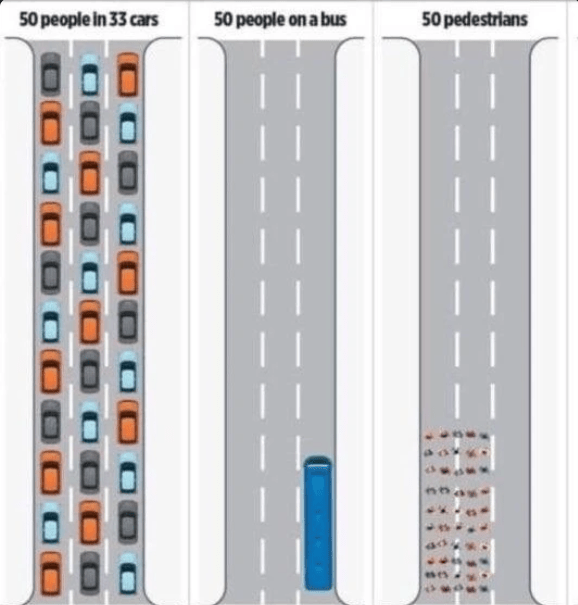
A 50:1 initiative is a project targeted at emptying our streets of cars and deciding more for public transport options. It basically means that if we manage to fill one bus, we may get up to 50 cars of the street. Implications of such a change can be substantial: less traffic and more flow on streets, less waiting in lines and less nervousness, more professional drivers on the road and thus more safety, less expenditure due to lower roads deterioration rate, less air pollution and less noise pollution, less parking lots and more space to use for other purposes, and so on.
Delivery of groceries
I know there are views that say this “last few kilometers delivery is the devil”. However, I would like to point out two results, which I see as positives:
- One, it works in the same principles as the 50:1 initiative: instead of having 20, 30, or 50 cars on the road, there is one delivery vehicle doing all the riding. In doing so, providers can optimise their routes and this can bring substantially lower emission values. (I’ve been using SPAR Online and in their annual reports they also write about this routes optimisation process and reducing emissions.)
- Two, as it counts in policies connected to energy use and distribution: it is far simpler and quicker to oversee and to change one official vehicle (like swap to another type of fuel) or vehicles one company is using, than to change vehicles that 50 people are using.
Integrated mobility planning
There is an obligation for all the municipalities to switch to integrated planning of mobility (as well as energy use and consumption). According to traditional planning, each public transport provider plans on its own. Very much likely, this brings us to a situation in which one group of passengers are not provided for, or to have some other undesirable result. Integrated planning obliges planning personnel to, again, think in broader terms, i. e. how to get all groups of passengers from location A to B through combining various modes of transport. It leans on principle of intermodality and on power of collaboration.
Among the results of integrated planning are solutions like bike renting, taking a bike to a train (i. e. piggybacking), P&R parking lots (i. e. park your vehicle and ride on with public transport), building locations of public transport closer to each other and alignment of riding timetables (so it is easier to switch), etc.
Conclusion
As I stated before, to my mind sustainable means taking more views, needs, more aspects of life and more people into account. Initiatives like one mentioned above are ones I always like to see happening and developing.
I want to post another thought for this conclusion. A few days ago I heard the famous “if I keep on doing what I do, it is just a small drop in the sea and it doesn’t reall matter”. This reminds me of a thought that swirles around in democratic leadership thought: we don’t really need big leaders who will take on the burden and do all the work. No, we just need all of us to do our little part. And that one was true in a way: it is not that big a deal. So, why not just do it?
 Paradim